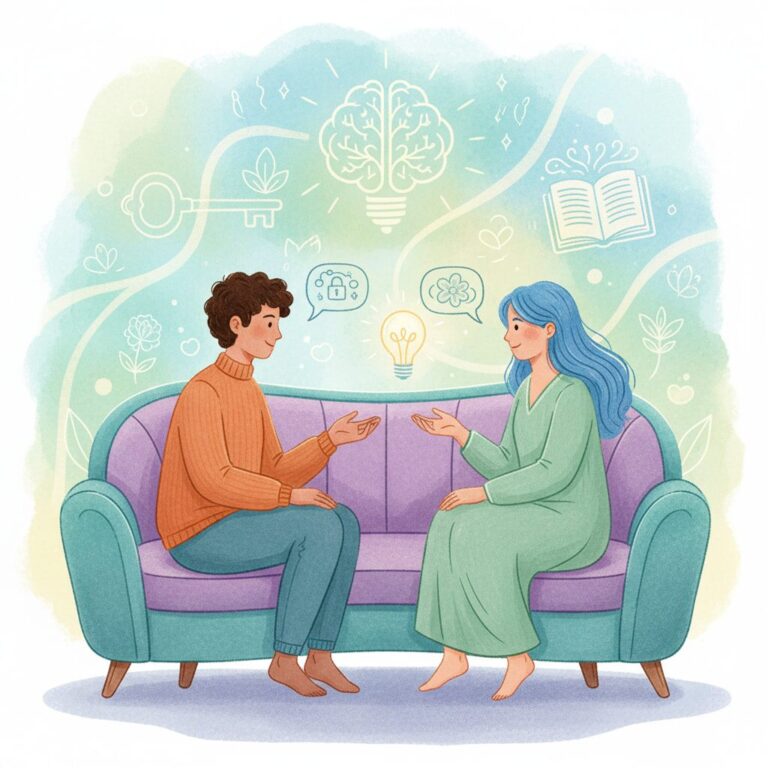
If you’ve ever lain in bed next to someone you love and felt… nothing — or worse, felt a wave of anxiety wash over you at the thought of being touched — you’re not broken. You’re not failing. And you’re definitely not alone.
Mental health and intimacy are tangled up in each other in ways that don’t get talked about nearly enough. When your brain is fighting anxiety or depression, your body often follows — and desire, arousal, and connection can take a real hit. The cruelty of it is that intimacy can actually help mental health, but mental health can make intimacy feel impossible. It’s a vicious loop that can leave both partners confused, hurt, and isolated.
This article isn’t about fixing yourself or your partner. It’s about understanding what’s actually happening in your brain and body, finding compassion for where you are right now, and picking up a few practical tools to gently reconnect — on your own terms, at your own pace.
Why Your Brain Puts the Brakes on Desire
Let’s start with what’s actually going on under the hood. When you’re dealing with depression or anxiety, your brain isn’t operating in “connection mode.” It’s in survival mode.
Depression dampens the brain’s reward system — the same system that lights up when you feel desire, pleasure, and closeness. It’s not that you don’t want intimacy. It’s that the neurochemical pathway that makes intimacy feel good is running on low battery. Anxiety, on the other hand, keeps your nervous system in a state of high alert. Your body is too busy scanning for threats to relax into pleasure. From a biological standpoint, it makes perfect sense: your brain isn’t going to prioritize sex when it thinks there’s a tiger in the room — even if that “tiger” is just your racing thoughts at 3 a.m.
Research backs this up. A 2025 study published in BMC Public Health found that both depression and perceived stress significantly disrupt core areas of sexual function — desire, arousal, orgasm, and overall satisfaction. The relationship goes both ways, too: sexual difficulties can deepen feelings of inadequacy and depression, creating a cycle that feels tough to break.
If you’ve learned about the Dual Control Model of arousal — the idea that your brain has both a sexual “accelerator” and sexual “brakes” — here’s where it becomes really useful. Depression and anxiety aren’t just turning down the accelerator. They’re stomping on the brakes. Understanding this can take away some of the self-blame. Your body isn’t rejecting intimacy. It’s responding exactly the way a stressed, overwhelmed nervous system is designed to respond.
When Medication Affects Your Sex Life
This part is important because it’s one of the most common — and least discussed — reasons intimacy stalls. If you’re taking an antidepressant, particularly an SSRI (like sertraline, fluoxetine, or paroxetine), sexual side effects are not rare. They’re the norm.
Studies report that anywhere from 58% to 73% of people on SSRIs experience some form of sexual dysfunction — most commonly reduced libido, difficulty reaching orgasm, or delayed ejaculation. Among those taking paroxetine specifically, nearly 60% report decreased libido. To put that in perspective: even untreated depression carries a sexual dysfunction rate of around 35% to 50%. The medication that helps your mood can, for many people, make intimacy harder.
Here’s what’s crucial to understand: this is not your fault, and it’s not something you just have to accept in silence. There are options. Some people find that adjusting the timing of their dose helps. Others switch to medications with lower sexual side effect profiles (bupropion and mirtazapine, for example, tend to be gentler in this area). Sometimes adding a low dose of bupropion alongside an SSRI can help. The key thing is to talk to your doctor. I know that conversation can feel awkward, but sexual health is health — and your prescribing physician has heard it all before, trust me.
If You’re the Partner Struggling with Mental Health
First, a deep breath. You’re carrying a lot. Navigating mental health challenges is exhausting on its own. Feeling like you’re also letting your partner down in the bedroom can layer guilt on top of everything else. Let’s set one thing straight: your worth as a partner is not measured by your libido.
That said, if you want to find ways back to connection — for yourself, not just for your partner — here are some gentle starting points:
- Stop pushing yourself to feel desire first. Many people with depression find that desire follows arousal, not the other way around. This is called responsive desire, and it’s completely normal. Try reframing intimacy as “let’s just be physically close and see what happens” rather than “I need to get in the mood.”
- Non-sexual touch is your friend. Holding hands, back rubs, cuddling without expectation — these activate oxytocin (the bonding hormone) and help calm an overactive nervous system. They’re also a low-pressure way to feel close.
- Talk to your partner about what’s happening in your brain. You don’t need to give a clinical lecture. “I miss being close with you, and I want you to know that my low desire isn’t about how much I love or want you — my brain is just struggling right now” can be a game-changer.
- Consider talking to a therapist who specializes in both mental health and sexuality. They exist, and they can help untangle what’s depression, what’s medication, and what might be something else entirely.
If Your Partner Is the One Struggling
Being the partner of someone with depression or anxiety comes with its own weight. You might feel rejected, worried, frustrated, or guilty for even having those feelings. All of that is valid.
The most important thing you can do is separate their mental health from your self-worth. When your partner pulls away physically, it’s almost never about you. Depression flattens desire indiscriminately — it doesn’t selectively target one partner. Reminding yourself of this can soften the sting.
Here are some ways to show up that actually help:
- Don’t try to cheer them up or fix them. It’s natural to want to point out the positives or offer solutions, but this often makes someone with depression feel more alone. Instead, try: “I’m here. You don’t have to feel better right now. I’m not going anywhere.”
- Initiate non-sexual affection without an agenda. A hug that doesn’t lead anywhere. A kiss on the forehead. The message is: I value being close to you, and there’s no pressure for it to be more.
- Ask what kind of support feels good to them. For some, it’s practical help (making dinner, handling a stressful task). For others, it’s just sitting together in silence. Don’t guess — ask, gently.
- Take care of your own mental health. Supporting a partner through depression can be draining. You can’t pour from an empty cup. Therapy, exercise, time with friends — these aren’t indulgences, they’re maintenance.
Small Steps to Rebuild Connection (Without Pressure)
When intimacy has been off the table for a while, jumping straight back into sex can feel overwhelming — for both of you. The goal isn’t to get “back to normal” overnight. It’s to rebuild a foundation of physical closeness that feels safe and good.
Here are a few approaches that therapists often recommend:
- Try Sensate Focus exercises. Developed by sex researchers Masters and Johnson, these are structured touch exercises that intentionally take intercourse off the table. You start with non-sexual touching and gradually progress — always at a pace that feels comfortable for both of you. The idea is to retrain your brain to associate touch with relaxation instead of pressure.
- Schedule “connection time” — and make it about presence, not performance. Pick a time when you’re both relatively rested. Light a candle, put on music you both like, and agree ahead of time that there’s no goal. Maybe you give each other a shoulder rub. Maybe you just lie together and breathe. The point is showing up, not achieving anything.
- Practice synchronized breathing. Lie facing each other, make gentle eye contact if that feels okay, and simply breathe together. Match your inhales and exhales for two or three minutes. It sounds simple, but it activates the parasympathetic nervous system — the “rest and digest” mode — and can create a surprising sense of closeness.
- Celebrate the small wins. If you held hands for five minutes and it felt good, that’s a win. If you had a conversation about how you’re both feeling without it turning into an argument, that’s a win. Progress in this area often looks quiet and incremental. Notice it.
Frequently Asked Questions
Does stress really affect my sex drive, or is that just an excuse?
It’s absolutely real. Chronic stress elevates cortisol levels, which suppresses the production of sex hormones like testosterone and estrogen. Stress also activates the fight-or-flight response, which prioritizes survival over reproduction. If your body thinks it’s under threat — even if that “threat” is a work deadline or financial worry — desire takes a backseat. This is biology, not a character flaw.
Will going off my antidepressants fix my sex life?
Maybe — but that’s a decision to make with your doctor, never on your own. Stopping medication abruptly can cause withdrawal effects and a relapse of depression or anxiety, which can actually make sexual function worse than before. The better approach is to have an honest conversation with your prescriber about what you’re experiencing. There are often options: adjusting the dose, switching medications, or adding something to counteract the sexual side effects. You don’t have to choose between mental stability and a satisfying sex life.
How do I tell my partner that my low desire isn’t about them?
Pick a calm moment, outside the bedroom, and use “I” statements. Something like: “I know we haven’t been as physically close lately, and I want you to know it has nothing to do with how much I love you or how attracted I am to you. My brain is just really struggling right now, and it’s affecting my body’s ability to feel desire. I miss being close with you, and I want us to find ways to reconnect that work for both of us.” This kind of direct, vulnerable communication often brings more relief than you’d expect — your partner may have been quietly blaming themselves, too.
You’re Not Alone in This
Mental health challenges and intimacy struggles travel together more often than most people realize. If you’re in the thick of it right now — feeling disconnected, frustrated, or just numb — please know that this season doesn’t define your relationship or your worth.
The path back to connection rarely looks like a straight line. It looks like a conversation that felt a little easier than the last one. A hug that lasted a few seconds longer. A moment where you let yourself be held without flinching. Those moments add up. Be patient with yourself. Be patient with your partner. And when you need help — from a doctor, a therapist, or just a friend who gets it — ask for it.
You deserve to feel close. You deserve to feel good. And you get to take all the time you need to get there.
SpiceMinx may earn a small commission from products purchased through our links — at no extra cost to you.